
Pratham Sindhu Kumbh: Reawakening India’s Civilizational Soul at the Banks of the Sindhu
“Civilizations endure not merely through monuments and memories, but through traditions that continue to inspire generations. The Sindhu has flowed for millennia, carrying within its waters the story of India’s soul.”

The successful conclusion of the Pratham Sindhu Kumbh, organised alongside the historic 30th Sindhu Darshan Yatra at the sacred banks of the Sindhu River in Leh, Ladakh, marks a defining chapter in India’s continuing civilizational journey. More than a religious congregation, it was a monumental expression of India’s cultural resurgence, spiritual continuity, and national consciousness. The event revived an ancient connection between the people of India and the river that has shaped the nation’s identity since time immemorial.

For thousands of years, the Sindhu River has remained one of humanity’s greatest civilizational landmarks. Flowing majestically through the Himalayas, it nurtured one of the world’s earliest urban civilizations, inspired timeless philosophies, facilitated trade across continents, and became the spiritual lifeline of generations. The very names Sindhu, Hindu, and ultimately India derive from this sacred river, making it not merely a geographical entity but the fountainhead of India’s identity.
Unlike many civilizations that survive only in archaeological remains, the civilization of the Sindhu continues to live through India’s traditions, values, philosophies, festivals, and collective consciousness. Every generation has inherited its spiritual wisdom, cultural diversity, and universal outlook. The Pratham Sindhu Kumbh served as a reminder that India’s civilizational heritage is not confined to history books; it remains a living force guiding the nation’s present and future.
The six-day celebration transformed the banks of the Sindhu into a confluence of faith, culture, scholarship, diplomacy, patriotism, and spiritual awakening. Thousands of pilgrims from every corner of the country assembled alongside revered saints, scholars, public representatives, youth, artists, diplomats, defence personnel, local residents, and visitors to celebrate not merely a river, but the very essence of Bharat.
Among the most historic and spiritually significant events was the Kalash Yatra, symbolising the unity of humanity through sacred waters. Holy water collected from 156 countries across the globe was ceremoniously carried in beautifully decorated Kalashs and offered as Jal Abhishek to the sacred Sindhu River. The symbolism of this extraordinary ritual transcended religious boundaries. As waters from distant continents merged into the eternal flow of the Sindhu, they represented the coming together of nations, cultures, civilizations, and humanity itself in a prayer for universal peace and harmony.
This magnificent ceremony transformed the Sindhu into a global spiritual confluence. It reaffirmed India’s timeless philosophy of “Vasudhaiva Kutumbakam”—the entire world is one family. The Jal Abhishek with sacred waters from 156 countries was not merely a ritualistic offering; it became a powerful civilizational message that despite differences of nationality, language, culture, and geography, humanity ultimately shares one common destiny.
Adding remarkable international significance to the occasion was the gracious presence of Ambassadors from eight countries, who participated in various ceremonies and witnessed India’s rich civilizational heritage firsthand. Their participation reflected growing global appreciation for India’s spiritual traditions and cultural values. It demonstrated that the message emanating from the banks of the Sindhu is not limited by national boundaries but resonates with people across the world who seek peace, dialogue, coexistence, and mutual respect.
The participation of these ambassadors transformed the Pratham Sindhu Kumbh into an occasion of cultural diplomacy. In an increasingly interconnected world, civilizations communicate not merely through economic partnerships or political engagements but also through cultural understanding and shared heritage. The Sindhu became a bridge connecting India with the international community, showcasing the country’s enduring commitment to peace, harmony, and universal brotherhood.
The sacred Sindhu Puja, accompanied by Vedic chanting, devotional hymns, traditional rituals, and collective prayers, created an atmosphere of profound spiritual energy. Revered saints representing diverse spiritual traditions offered prayers for national prosperity, global peace, environmental harmony, and the welfare of humanity. The rituals reflected India’s unique spiritual tradition where diversity is celebrated without compromising unity.
Unlike gatherings limited by sectarian identities, the Pratham Sindhu Kumbh stood as a celebration of inclusiveness. It brought together people from different faiths, linguistic backgrounds, regions, professions, and generations under one shared civilizational identity. The banks of the Sindhu became a living testament to India’s pluralistic ethos, where countless traditions flourish together while remaining united by common values.
One of the intellectual highlights of the celebration was the International Conference on “Vishva Shanti”, organised at the University of Ladakh. Scholars, diplomats, policymakers, academicians, and spiritual leaders deliberated upon some of the most pressing challenges confronting humanity—armed conflicts, environmental degradation, social polarization, terrorism, technological disruptions, and declining human values. The conference explored how India’s civilizational wisdom, nurtured for centuries along the Sindhu, continues to offer practical guidance for building a peaceful, inclusive, and sustainable global future.
The discussions repeatedly returned to the timeless principle of Vasudhaiva Kutumbakam, emphasising that enduring peace cannot be achieved merely through treaties or negotiations but through cultivating mutual respect, compassion, dialogue, and shared responsibility among nations. In this context, the Sindhu emerged not only as a sacred river but also as a timeless symbol of coexistence and human unity.
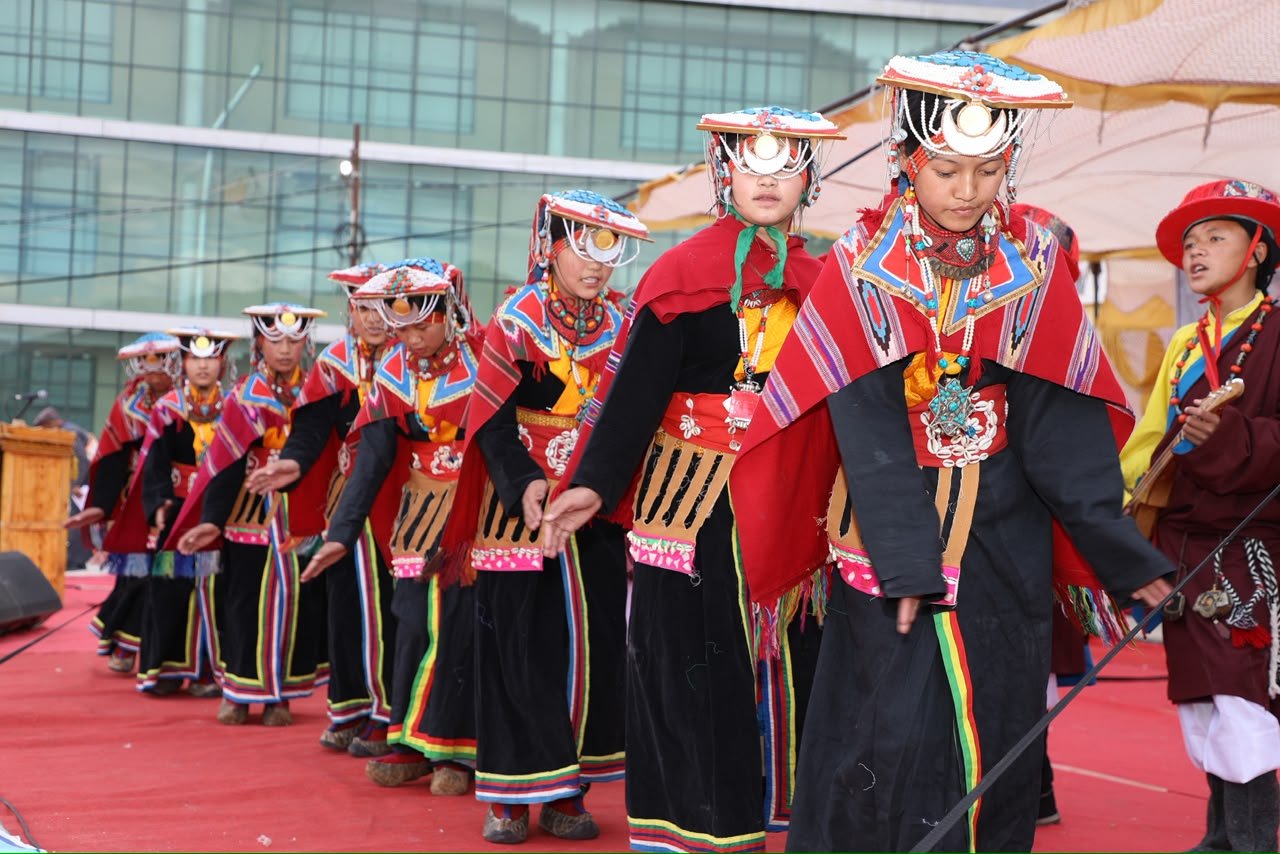
The celebration was equally enriched by spectacular cultural performances presented under the inspiring theme “Ek Bharat Shreshtha Bharat.” Artists representing every region of India showcased classical dances, folk traditions, devotional music, martial arts, and indigenous cultural expressions. Each performance highlighted regional uniqueness while collectively celebrating India’s fundamental unity. The audience witnessed how extraordinary diversity has always been the greatest strength of Indian civilization
Ladakh: Where Civilization Meets the Himalayas
There could scarcely have been a more fitting setting for such a monumental gathering than Ladakh. Nestled amidst the majestic Himalayas and positioned at the crossroads of ancient civilizations, Ladakh has for centuries served as a meeting point of cultures, faiths and trade routes. The region connected the Indian subcontinent with Central Asia, Tibet and beyond, enabling not only the exchange of goods but also of ideas, philosophies and spiritual traditions. From Buddhist monasteries perched atop mountains to ancient caravan routes that once echoed with merchants and pilgrims, Ladakh has always embodied India’s enduring spirit of peaceful coexistence and cultural dialogue.
The Sindhu River, flowing through this magnificent landscape, has silently nurtured these interactions for centuries. Hosting the Pratham Sindhu Kumbh on its sacred banks therefore carried profound symbolism. It reaffirmed Ladakh’s historic role as a bridge between civilizations while reinforcing its place at the heart of India’s civilizational narrative.
Thirty Years of Sindhu Darshan: From a Pilgrimage to a National Movement
The year also marked the successful completion of the 30th Sindhu Darshan Yatra, a journey that has evolved into one of India’s most significant cultural and spiritual movements. What began three decades ago as an effort to reconnect Indians with the river that gave the nation its identity has today become a powerful symbol of national integration and cultural pride.
Every year, pilgrims from across India undertake this sacred journey to pay homage to the Sindhu. Over the years, the Yatra has strengthened emotional integration among diverse communities, reminding every Indian that despite differences in language, customs and geography, they share a common civilizational heritage.
The inauguration of the Pratham Sindhu Kumbh marks a natural and historic progression of this movement. It expanded the scope of the Sindhu Darshan Yatra beyond pilgrimage by integrating spirituality, scholarship, diplomacy, cultural exchange and national consciousness into one grand celebration.
Faith Rooted in Inclusivity
One of the defining strengths of the Pratham Sindhu Kumbh was its inclusive spirit. Saints and spiritual leaders representing diverse traditions participated together in prayers and deliberations. Their collective presence reaffirmed a fundamental truth about Indian civilization—that unity is achieved not through uniformity but through mutual respect and harmonious coexistence.
The gathering brought together monks, saints, scholars, youth, public representatives, members of civil society, artists, diplomats, defence personnel and ordinary citizens. Every participant became part of a larger spiritual family united by reverence for the Sindhu and by pride in India’s shared heritage.
The ceremonies demonstrated that India’s spiritual traditions have always welcomed dialogue, diversity and coexistence. The Sindhu became a sacred meeting ground where ancient wisdom found renewed expression in a modern democratic nation.
The Tricolour and the Spirit of National Unity
One of the most moving moments of the six-day celebration unfolded when thousands of participants proudly raised the Indian Tricolour on the banks of the Sindhu. Against the breathtaking backdrop of the Himalayas, the sight of saints, pilgrims, soldiers, students, women, youth and citizens standing together under one national flag created an unforgettable image of unity.
The collective pledge to uphold the unity, integrity and sovereignty of India reflected the inseparable relationship between spirituality and patriotism that has characterized India’s civilizational journey for centuries. Devotion to the sacred river seamlessly merged with devotion to the nation.
The Tricolour fluttering beside the timeless Sindhu symbolized continuity—linking India’s ancient civilization with its modern democratic identity.
A Testament to Collective Effort
The resounding success of the Pratham Sindhu Kumbh was the result of extraordinary teamwork and meticulous planning. The Union Territory Administration of Ladakh, the Sindhu Darshan Yatra Samiti, local communities, volunteers, religious organisations, security forces, government departments and countless individuals worked tirelessly to ensure that every aspect of the event reflected excellence, discipline and hospitality.
From maintaining security and managing logistics to facilitating pilgrim services, cultural programmes and international participation, every stakeholder contributed with dedication and professionalism. Their coordinated efforts transformed the event into a seamless and memorable experience for thousands of visitors.
The warmth and generosity displayed by the people of Ladakh once again demonstrated why the region is celebrated for its unique tradition of hospitality and communal harmony.
A New Chapter in India’s Cultural Renaissance
The significance of the Pratham Sindhu Kumbh extends far beyond the boundaries of Ladakh. At a time when many societies across the world are searching for deeper cultural roots and shared values, India has offered an inspiring example of how ancient traditions can remain relevant in the modern world.
The Kumbh reaffirmed that preserving civilizational heritage is not an exercise in nostalgia. Rather, it is a conscious effort to carry forward timeless values that strengthen society and inspire future generations. The ideals of compassion, harmony, respect for nature, peaceful coexistence and national unity remain as relevant today as they were thousands of years ago.
The ceremonial Jal Abhishek of the Sindhu with sacred waters collected from 156 countries powerfully illustrated that India’s civilizational vision embraces the entire world. Likewise, the participation of Ambassadors from eight countries demonstrated that India’s cultural heritage possesses universal appeal and continues to inspire dialogue among nations.
The International Conference on “Vishva Shanti” further reinforced that India’s ancient philosophy offers meaningful solutions to contemporary global challenges. The message emerging from the banks of the Sindhu was clear: lasting peace can only be achieved through understanding, mutual respect and recognition of our shared humanity.
The Eternal Flow of the Sindhu
For thousands of years, the Sindhu has flowed uninterrupted through mountains, valleys and civilizations. It has witnessed the birth of cities, the rise of kingdoms, the spread of philosophies, the journeys of saints and the aspirations of countless generations. It has remained constant while history transformed around it.
The Pratham Sindhu Kumbh rekindled that eternal connection between the river and the nation. It reminded every participant that India’s greatest strength lies not merely in its economic progress or technological achievements but in its civilizational continuity—a continuity rooted in values that have endured for millennia.
The sacred waters of the Sindhu continue to whisper the timeless message of unity amidst diversity, faith alongside reason, patriotism with universal brotherhood and development guided by cultural wisdom.
As sacred waters from 156 countries merged with the Sindhu through the Kalash Yatra and Jal Abhishek, humanity witnessed a profound symbol of global fraternity. As Ambassadors from eight nations stood on the banks of the river that gave India its name, the world witnessed the enduring relevance of India’s civilizational philosophy.
The Pratham Sindhu Kumbh was therefore much more than a religious congregation. It was a celebration of India’s timeless identity, a reaffirmation of its cultural confidence, a tribute to its spiritual heritage and a declaration that the values nurtured on the banks of the Sindhu—peace, harmony, compassion, unity and universal brotherhood—will continue to guide not only India but also inspire the world.
As the Sindhu flows endlessly towards the sea, so too does the spirit of Indian civilization—ever ancient, ever new, carrying forward an eternal message of hope, harmony and human unity for generations yet to come.

ANN News is the first and only 24*7 Tv News Channel of Kashmir, having its headquarters at Srinagar. ANN News is available on all leading cable Networks, Also Available On JIO Tv , Vodafone,TataPlay , Candor Network, Dailyhunt and other leading Platforms