
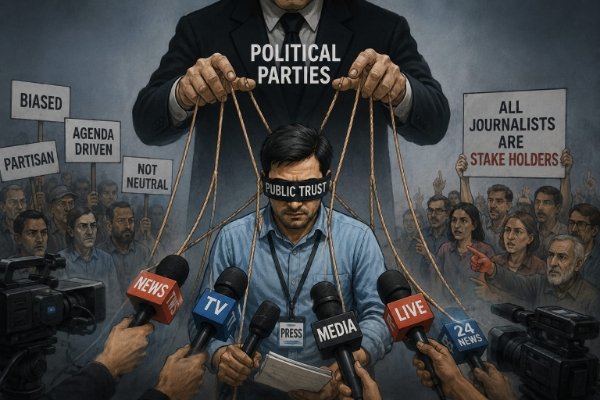
When a Few Become Political Mouthpieces, the Entire Press Pays the Price.
Politicisation of Journalism and the Growing Crisis of Public Trust
Arif Rashid
Anantnag, June 30: Journalism has long been regarded as one of the pillars of democracy, with the primary responsibility of informing the public through accurate, impartial and fact-based reporting. However, in recent years, increasing concerns have emerged over the growing perception that sections of the media have become closely aligned with political parties and ideological interests. Media observers believe this trend is gradually eroding public confidence in the profession and affecting the credibility of journalists across the board.
The role of a journalist is to question those in power, verify information and present multiple perspectives so that citizens can make informed decisions. When journalists are perceived as promoting the interests of political parties rather than serving the public interest, the distinction between journalism and political advocacy begins to blur. While such perceptions may not apply to the profession as a whole, they can have far-reaching consequences for public trust.
Several senior journalists and media experts have expressed concern that the actions of a relatively small section of media professionals are increasingly shaping public opinion about the entire fraternity. As a result, many independent journalists who continue to adhere to ethical standards often find themselves facing the same criticism, suspicion and hostility directed at those accused of partisan reporting.
This changing perception has become particularly visible on social media platforms, where journalists are frequently labelled according to political affiliations instead of being evaluated on the basis of their reporting. News stories are often judged through a political lens, and journalists covering sensitive issues sometimes face online abuse, trolling or allegations of bias regardless of the facts presented in their reports.
Another issue being highlighted by media observers is the growing tendency of some political leaders and party representatives to dismiss uncomfortable questions by branding journalists as “biased,” “agenda-driven,” or politically motivated. Instead of responding to questions concerning governance, development, public welfare, unemployment, healthcare, education, corruption or civic issues, attention is sometimes diverted towards questioning the credibility of the journalist asking them.
According to observers, asking difficult questions is not an act of political opposition but one of the core responsibilities of journalism. A free and independent press exists to seek answers on behalf of the public, regardless of which political party is in power. When journalists are criticised merely for seeking accountability, it can discourage independent reporting and create an environment where scrutiny is viewed as hostility rather than an essential democratic function.
Media analysts argue that the problem is not merely about political opinions. Every journalist is entitled to personal beliefs. The real concern arises when professional reporting appears to be influenced by political loyalty, selective presentation of facts or the omission of information that does not suit a particular narrative. Such practices, whether real or perceived, weaken public confidence in journalism as an independent institution.
The consequences extend beyond individual journalists. As public trust declines, even factual reporting is questioned. Reporters covering issues related to governance, corruption, law enforcement, elections or public welfare often encounter scepticism simply because audiences have become increasingly doubtful about the neutrality of the media. This environment makes it more difficult for responsible journalists to perform their duties effectively.
Press freedom advocates have repeatedly emphasized that editorial independence remains the cornerstone of credible journalism. They argue that news organisations must ensure a clear separation between reporting, opinion and political advocacy. Likewise, public officials are expected to respond to legitimate questions with transparency and facts rather than questioning the motives of those asking them. Transparency, rigorous fact-checking, balanced reporting and accountability are considered essential to rebuilding public confidence.
Media educators also stress the importance of strengthening ethical journalism through continuous professional training and adherence to recognised journalistic standards. They believe that credibility is earned through consistency, fairness and accuracy rather than through alignment with any political ideology.
Observers point out that criticism of journalism should also remain balanced. Isolated instances of unethical reporting should not be used to undermine the work of thousands of journalists who continue to report responsibly, often under difficult circumstances and significant personal risk. Generalising the actions of a few can unfairly damage the reputation of the profession as a whole.
As the media landscape continues to evolve, experts believe the future of journalism will depend largely on its ability to maintain independence, uphold ethical principles and place public interest above political considerations. Restoring trust will require sustained efforts from journalists, editors, media organisations, public representatives and audiences alike.
Ultimately, the credibility of journalism is not determined by proximity to power but by its commitment to truth, fairness and accountability. In an era of increasing misinformation and political polarisation, preserving these values remains essential for a healthy democratic society.

ANN News is the first and only 24*7 Tv News Channel of Kashmir, having its headquarters at Srinagar. ANN News is available on all leading cable Networks, Also Available On JIO Tv , Vodafone,TataPlay , Candor Network, Dailyhunt and other leading Platforms