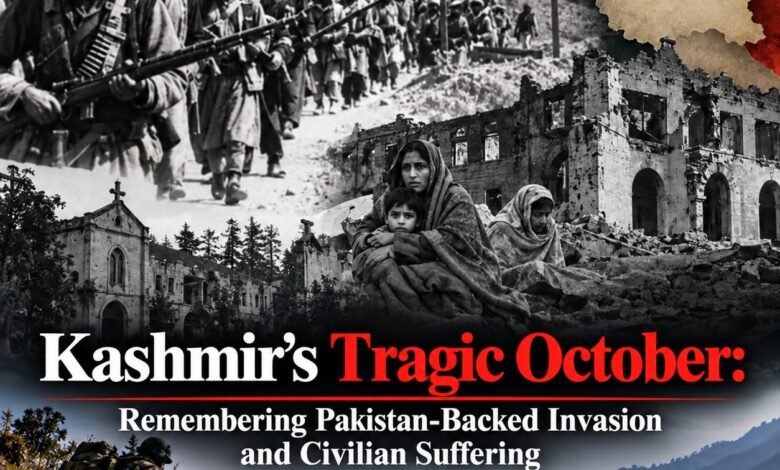
Kashmir’s Tragic October: Remembering Pakistan-Backed Invasion and Civilian Suffering
79 years after the Pakistan-backed tribal invasion of October 22, 1947, Kashmir remembers the civilian suffering, the tragedy of Baramulla and a conflict that continues to shape the region’s history.
October 22, 1947, remains one of the darkest dates in the history of Jammu and Kashmir. On this day, Pakistan-backed Pashtun tribal fighters invaded Kashmir, triggering violence, civilian suffering and a conflict whose consequences continue to shape the region. Seventy-nine years later, the anniversary is a reminder of the human cost of pursuing territorial ambitions through armed force and of Pakistan’s role in an invasion that changed Kashmir’s history.
On October 22, tribal fighters entered Jammu and Kashmir through the Muzaffarabad sector and advanced towards Srinagar along the Jhelum Valley route. Historical accounts and contemporary records indicate that the operation received assistance from elements of Pakistan’s political and military establishment. While historians have debated the precise extent of official authorisation and the chain of command, Pakistan’s logistical and strategic involvement remains a significant part of the historical record.
The invasion exposed a fundamental contradiction in Pakistan’s claim to represent Kashmir’s Muslim-majority population. Instead of allowing the political future of the state to be determined through a peaceful process, the armed advance placed civilians in danger and subjected communities to violence. Religious affinity could not provide a moral justification for imposing a political outcome through force.
Baramulla became one of the most painful symbols of the invasion. Historical accounts describe killings, looting and attacks on civilians as the raiders advanced towards Srinagar. The assault on St Joseph’s Convent and Hospital, where members of the religious community, patients and others were killed, remains among the most disturbing episodes associated with the campaign. Andrew Whitehead’s book A Mission in Kashmir documents the events and their human consequences.
For ordinary people, the invasion was not an abstract struggle over territory. It meant fear, loss of life and the destruction of the security of their homes and communities. The suffering of civilians must remain central to any honest account of 1947 rather than being overshadowed by competing national narratives.
The chronology of accession is equally important. Facing the advancing forces, Maharaja Hari Singh signed the Instrument of Accession to India on October 26, 1947. Governor-General Lord Mountbatten accepted it on October 27, the day Indian troops began arriving in Srinagar. The invasion had therefore begun before the accession was signed. This sequence challenges attempts to portray the tribal incursion simply as a response to Kashmir’s accession to India.
Pakistan contested the accession, while India relied on the Instrument as the legal basis for its intervention. Kashmir’s political aspirations, the Maharaja’s authority and the question of popular consent remain important subjects of historical debate. However, those disagreements cannot erase the chronology of the invasion or justify the violence that accompanied it.
The international record also deserves attention. In April 1948, the United Nations Security Council adopted Resolution 47, which called on Pakistan to use its best endeavours to secure the withdrawal of tribesmen and Pakistani nationals who had entered Jammu and Kashmir to fight. Although the resolution’s proposed arrangements were never fully implemented, it remains an important document in understanding the international response to the conflict.
The invasion contributed to the first India-Pakistan war, the division of the former princely state and decades of mistrust. Families were separated, political positions hardened and generations inherited a conflict that has repeatedly placed ordinary Kashmiris at the centre of competing territorial claims.
Pakistan’s role in October 1947 must be judged through historical evidence and the actions of those who enabled the invasion. Condemning that role does not mean blaming ordinary Pakistanis or the Pashtun community collectively. Accountability belongs to the political and military actors responsible, not to entire populations.
Seventy-nine years later, the legacy of October 22 remains relevant as Pakistan-based groups and networks every now and then attempt to infiltrate terrorists into Jammu and Kashmir.
This article is written by Syed Imtiyaz and is based on his research and analysis. The views and opinions expressed are his own and do not necessarily reflect the editorial position of ANN News.

ANN News is the first and only 24*7 Tv News Channel of Kashmir, having its headquarters at Srinagar. ANN News is available on all leading cable Networks, Also Available On JIO Tv , Vodafone,TataPlay , Candor Network, Dailyhunt and other leading Platforms