Hangor Deal Under Scrutiny: Fears Grow Over ‘Another Agosta-Style Corruption Scandal’ in Pakistan
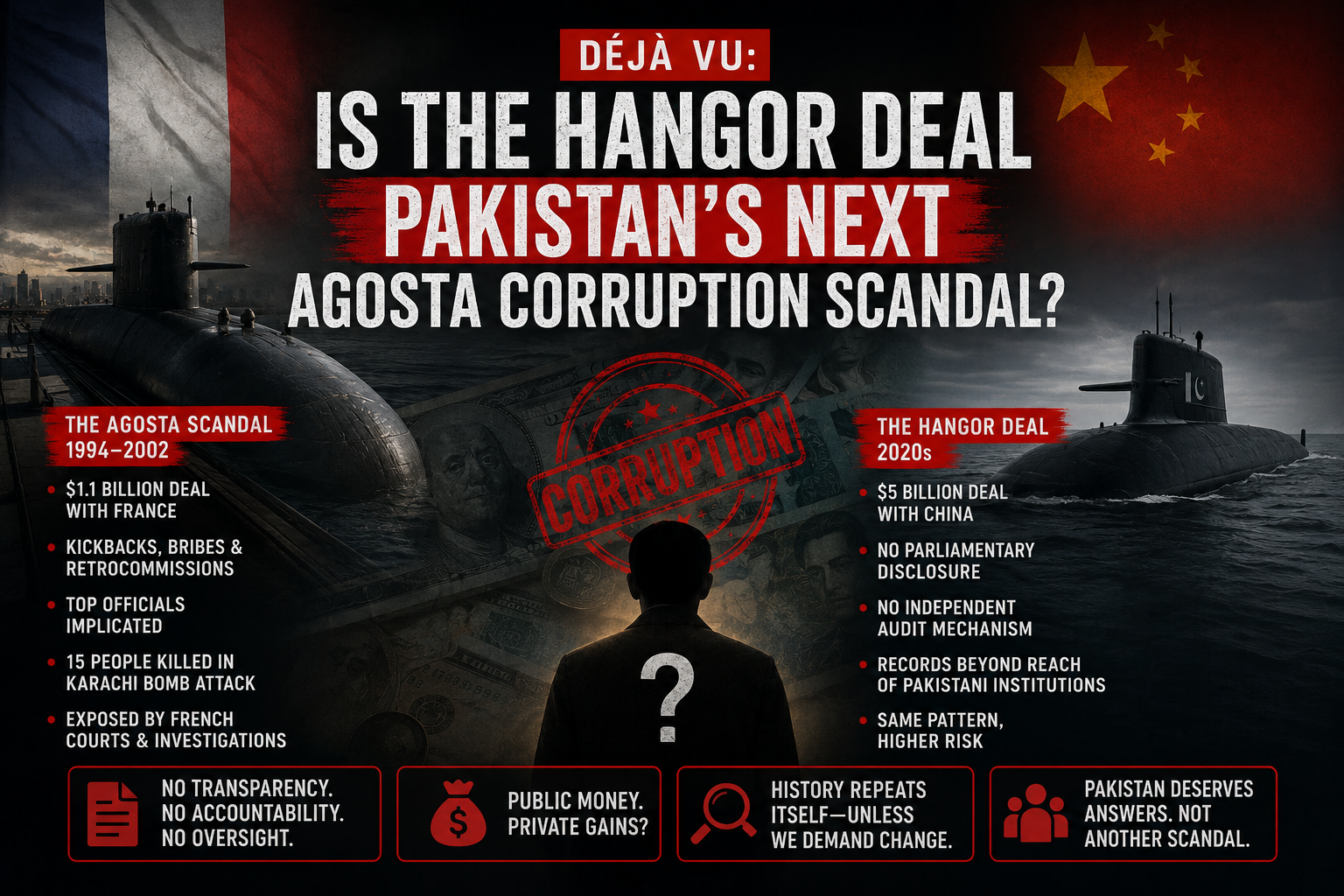
In 1994, Pakistan signed a contract with French state-owned defence manufacturer DCN for three Agosta 90B submarines at approximately 1.1 billion euros. The deal was concluded between Prime Minister Benazir Bhutto and President François Mitterrand. Within years, it had become one of the most consequential corruption cases in the history of French and Pakistani defence procurement.
French judicial proceedings eventually established that a network of kickbacks and retrocommissions — bribes disguised as consulting fees — had been routed through intermediaries on both sides of the transaction. Pakistan’s Chief of Naval Staff, Admiral Mansur ul Haq, was extradited from the United States, arrested, and ultimately admitted under a plea deal to receiving kickbacks across multiple arms contracts. He was fined and stripped of rank. On the French side, former Prime Minister Édouard Balladur and former Defence Minister François Léotard were charged with complicity in misuse of corporate assets, with prosecutors alleging that funds from the submarine deal were channelled back to finance Balladur’s 1995 presidential campaign.
In 2020, a Paris court convicted six people, including three former French government officials. Documents seized during French proceedings also implicated Asif Ali Zardari, allegations his party denied.
The human cost of the scandal did not stop at financial wrongdoing. On May 8, 2002, a suicide bomber killed 15 people outside the Sheraton hotel in Karachi, 11 of them French engineers working on the submarine programme. French investigators concluded the attack was most likely an act of revenge after President Jacques Chirac ordered the commission payments stopped when France criminalised the practice in 2000. A financial dispute over kickbacks had produced a body count.
Pakistan’s domestic accountability mechanisms played no meaningful role in uncovering any of this. No high-level Pakistani inquiry was ever conducted. The reckoning came entirely through French judicial proceedings, French investigative journalism, and the access French courts had to financial records on their side of the transaction. Pakistan was a passive recipient of disclosures it could not have generated itself.
The Hangor deal — $5 billion, financed through Chinese state entities, contracted between government establishments on both sides — is now in progress under the same structural conditions that made the Agosta scandal possible. Pakistan’s parliament has not been presented with detailed contract documentation.
The ancillary agreements that accompany a programme of this scale — spare parts supply, maintenance simulators, crew training packages, software upgrade kits — each represent independent revenue streams that can be structured to channel funds to favoured contractors or intermediaries without appearing in the headline transaction figure. None of these components is subject to an independent civilian audit.
The critical difference from the Agosta case is that the external accountability mechanism, which ultimately produced the Agosta disclosures, does not exist for the Hangor deal. France has an independent judiciary, investigative press, and financial regulators who could and did pursue records on their side of the transaction across two decades. China operates under none of those conditions. Chinese state procurement records are not accessible to Pakistani civil society, Pakistani parliamentary investigators, or independent courts. If the pattern from the Agosta deal is repeated in the Hangor programme, the mechanism that might one day expose it does not exist.
The red flags are not speculative. A $5 billion procurement with no parliamentary disclosure, no independent audit mechanism, a documented history of corruption in the identical category of contract, and a financing structure that places the relevant records permanently beyond the reach of Pakistani civilian institutions is, by any institutional standard, a high-risk environment for public money.
Pakistan’s citizens are bearing the cost of this programme through reduced social spending and continued IMF austerity. They have no mechanism to verify that the money is being spent cleanly, and this time, no French judge to find out for them.

ANN News is the first and only 24*7 Tv News Channel of Kashmir, having its headquarters at Srinagar. ANN News is available on all leading cable Networks, Also Available On JIO Tv , Vodafone,TataPlay , Candor Network, Dailyhunt and other leading Platforms