A Voice from Turtuk: Democracy Reaches One of India’s Northernmost Villages
As Ladakh holds its first panchayat elections since becoming a Union Territory, voters in the remote border village of Turtuk come out to choose their local representatives.
A Voice from Turtuk: Democracy Reaches One of India’s Northernmost Villages
As Ladakh holds its first panchayat elections since becoming a Union Territory, voters in the remote border village of Turtuk come out to choose their local representatives.
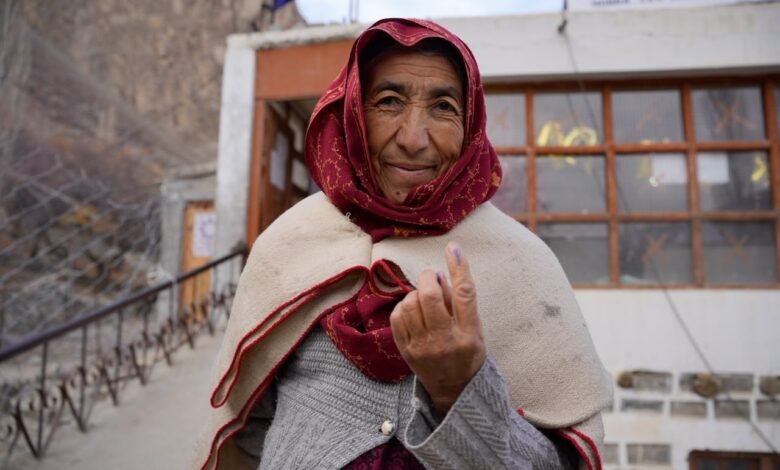
LEH, November 21: In Turtuk, a village of stone houses and apricot orchards on the banks of the Shyok river, Saturday was polling day. Residents of this remote border settlement in Ladakh’s Nubra Valley came out to vote in the Panchayat Elections 2026, adding their voices to a vote that carries special weight across the region.
These are Ladakh’s first panchayat elections since it became a Union Territory in 2019. The last panchayat polls were held in November 2018, when Ladakh was still part of the former state of Jammu and Kashmir. Seven years on, residents of 193 panchayats are once again choosing the people who will handle their village roads, water supply, schemes and day-to-day concerns.
Among those who voted in Turtuk was Niyaz Maha, a resident of Turtuk Farool. Speaking on polling day, he described voting as both a right and a responsibility, and said every resident has a part to play in choosing local representatives who understand the village’s needs.
A village with a history like no other
Few places in India have a story quite like Turtuk’s. Until December 1971, the village was under Pakistani administration. During the India–Pakistan war that year, Indian forces took control of it, and Turtuk has been part of India ever since. Its people are Balti, sharing language and culture with Baltistan across the Line of Control, and many families were separated by the war.
The village stayed closed to outsiders for decades and opened to tourists only in 2010. Today it draws visitors for its landscape and heritage. On polling day, however, the focus was on its own residents and their choice of who will speak for them.
Grassroots democracy at the frontier
Turtuk’s participation reflects a wider picture across Ladakh, where voters from distant valleys and border hamlets are coming forward despite the cold, long distances and difficult terrain of late November. Panchayats are the level of government closest to people in these areas. Decisions about drinking water, link roads, schools and welfare schemes are often shaped at this level, so the outcome matters directly to daily life.
The polls were announced by Ladakh’s State Election Commissioner, Sudhanshu Pandey, who said the entire process, including results, will be completed by November 30. The panchayat vote comes alongside elections in Leh and Kargil, while the reconstituted Hill Development Councils go to the polls on December 4.
For voters in Turtuk, though, the day was simpler than any schedule. Choosing their own village leaders, they showed that a village at the edge of the map can stand fully at the centre of India’s democracy.

ANN News is the first and only 24*7 Tv News Channel of Kashmir, having its headquarters at Srinagar. ANN News is available on all leading cable Networks, Also Available On JIO Tv , Vodafone,TataPlay , Candor Network, Dailyhunt and other leading Platforms