Jammu gets Region Meteorological Centre to boost weather forecasting, disaster preparedness
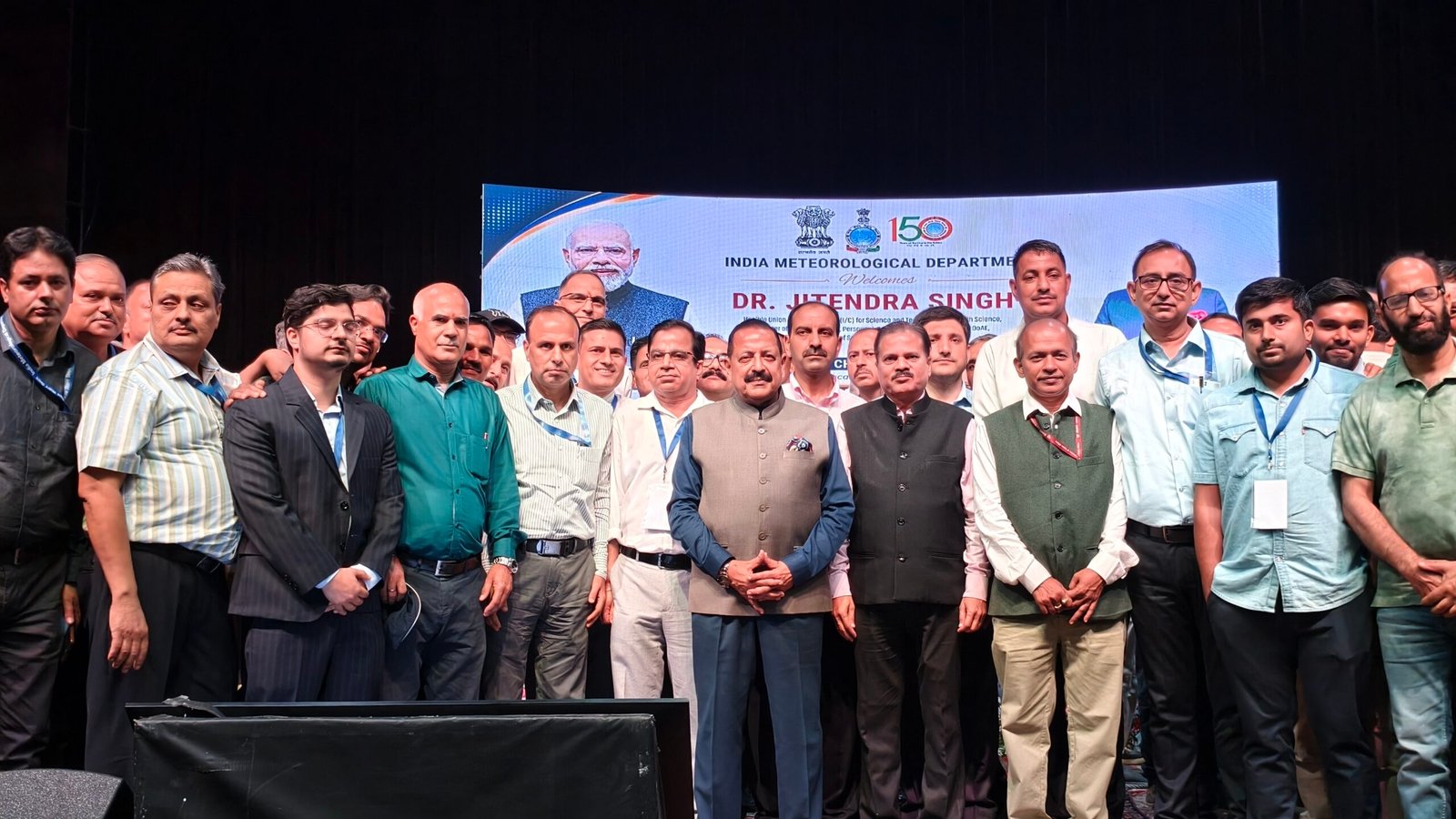
Jammu, Jun 5: Union Minister Jitendra Singh on Friday formally declared the establishment of a new Regional Meteorological Centre at Jammu, marking a major step towards strengthening weather forecasting and disaster preparedness across Jammu and Kashmir, Ladakh and Himachal Pradesh.
The newly established MeT centre at Jammu will integrate weather observations with a state-of-the-art X-band Doppler Weather Radar system and an expanded network of automatic weather stations, significantly enhancing real-time weather monitoring, forecasting accuracy and early warning capabilities across the northwestern Himalayan region, the officials said.
Singh said the centre would provide regional weather forecasting, district-wise forecasts and advanced nowcast services, enabling highly accurate weather predictions up to three hours in advance.
“Specialised weather forecasts will be issued for tourists, mountain regions and disaster management agencies. Dedicated forecasting services will also be available for sectors such as agriculture, aviation and pilgrimage-related helicopter operations,” he said.
The minister said the upgraded meteorological infrastructure would play a key role in minimising losses by natural disasters and contribute to the vision of a developed India.
“Timely forecasting and early warnings for flash floods, cloudbursts, avalanches, heavy snowfall, thunderstorms and landslides will help save lives and reduce economic losses. Separate forecasting mechanisms have been designed for flood management, aviation operations and farming activities,” he said.
He said the establishment of the Regional Meteorological Centre in Jammu marks a new chapter in the department’s long history and reflects the Centre’s focus on strengthening scientific infrastructure in the Himalayan region.
Referring to the region’s diverse agro-climatic conditions, Singh said weather advisories would be customised for different crops and farming systems.
“This is a unique region where mangoes grow in one area while apples are cultivated in another. Different categories of forecasts will be developed to cater to varied agricultural requirements,” he said.
Singh said specialised weather support would also be extended to helicopter services operating during the pilgrimage season, particularly around the Vaishno Devi Shrine area.
Highlighting the research component of the new centre, Singh said it would emerge as a hub for the Himalayan meteorological studies, helping scientists improve understanding of mountain weather systems and strengthen forecasting capabilities for high-altitude regions.
He said the establishment of the regional meteorological centre reflects the central government’s commitment to expanding scientific infrastructure and enhancing resilience against weather-related disasters in the strategically important Himalayan belt.
The minister said J&K has a long association with meteorological services. He noted that a weather observatory was established in Srinagar shortly after the India Meteorological Department was founded 151 years ago and has since been recognised by the World Meteorological Organisation (WMO) as a centennial meteorological observatory.
“Established during the British era, the department’s headquarters shifted over time from Bengal to Shimla, Pune and eventually Delhi, while regional centres were subsequently set up across major cities”.
Highlighting scientific advancements in the region, Singh said India’s first and the world’s second high-altitude cloud physics laboratory was established at Nathatop in collaboration with Switzerland.
“Situated at an altitude of around 10,000 feet, the facility enables scientists to study cloud droplets and aerosols and improve weather forecasting models,” he said.
The minister said seismic monitoring infrastructure has also been strengthened over the last decade, with stations established in Jammu, Srinagar and Udhampur.
He said the initiative reflects a “whole-of-government” approach, with the meteorological department signing memorandums of understanding with institutions in Jammu and Srinagar, as well as the Department of Science and Technology.
The minister also highlighted various infrastructure projects completed or revived in the Jammu region over the last decade, including the Shahpur Kandi Project, the Ujh Multipurpose Project, North India’s first Seed Processing Plant, the Industrial Biotech Park, and the Atal Setu at Basohli.
“The Shahpur Kandi Project remained stalled for nearly four decades despite its foundation stone being laid in 1984. Work began only after 2019, and the project has now been completed, enabling Jammu and Kashmir to utilise its rightful share of the Ravi river,” he said.
Singh said Jammu has emerged as a major hub of education, research and scientific institutions, adding that few cities in the country can match the concentration of important academic and scientific establishments located within a radius of six kilometres.
Among the dignitaries present in the inauguration were Minister for Sports Satesh Sharma, MP Jugal Kishore Sharma, senior officials of the India Meteorological Department, scientists and representatives of various institutions. (PTI)

ANN News is the first and only 24*7 Tv News Channel of Kashmir, having its headquarters at Srinagar. ANN News is available on all leading cable Networks, Also Available On JIO Tv , Vodafone,TataPlay , Candor Network, Dailyhunt and other leading Platforms