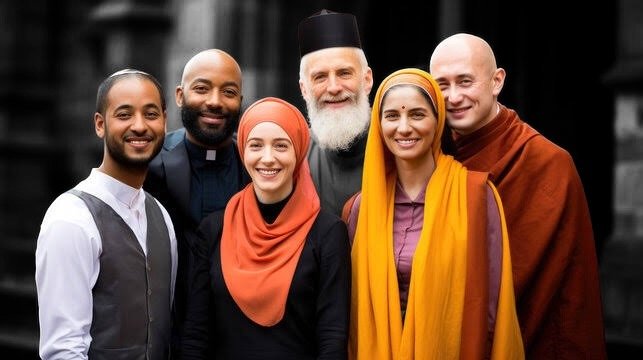
Tariq Bhat /Limya Mahajan
In a world where technology has bridged the physical gaps between people but divisions based on faith, culture, and politics persist, the call for religious unity has never been more urgent. Across history, religion has been a source of comfort, purpose, and moral guidance. Yet, it has also been a cause of conflict and division.
Despite these divisions, the core values shared by nearly all major faiths—compassion, peace, and respect for humanity—offer a powerful foundation for unity. As global challenges grow more complex, embracing these universal values can help humanity move toward a future of cooperation and understanding.
The Common Thread of Compassion
At the heart of every major religion is the call for kindness and empathy. Islam teaches compassion, with Prophet Muhammad’s (PBUH) famous saying, “None of you truly believes until he loves for his brother what he loves for himself,” urging believers to care for others. Similarly, Hinduism’s philosophy of Vasudhaiva Kutumbakam—the idea that “the world is one family”—encourages unity across all human differences.
In Christianity, the command to “love thy neighbor as thyself” (Mark 12:31) promotes unconditional love that transcends sectarian divisions, while Buddhism’s principles of karuna (compassion) and metta (loving-kindness) emphasize empathy and interconnectedness. Sikhism and Judaism both uphold the ideals of equality and responsibility to others, with the Guru Granth Sahib reminding followers that “God is one, and we are all His children,” and the Jewish concept of Tikkun Olam urging people to “repair the world” for the common good.
These shared values underscore that despite theological differences, the ethical teachings of all major faiths converge on a message of compassion and service to humanity.
Historical and Modern Examples of Religious Unity
Throughout history, there have been inspiring examples of religious unity that remind us what is possible when we come together. Mahatma Gandhi, a Hindu, and Maulana Abul Kalam Azad, a Muslim, worked side by side during India’s Independence Movement, proving that cooperation between faiths can fuel powerful, peaceful change. The Nizamuddin Dargah in Delhi, a Sufi shrine visited by both Hindus and Muslims, symbolizes the potential for religious spaces to serve as bridges between communities.
In more recent times, interfaith dialogues, such as those promoted by the Parliament of the World’s Religions, have created platforms for understanding, while peace efforts like the Good Friday Agreement in Northern Ireland have shown how religious leaders can foster reconciliation in divided societies.
The Role of Faith in Addressing Global Challenges
As the world faces crises ranging from climate change to political unrest, religious communities are uniquely positioned to help. Faith-based organizations such as Islamic Relief Worldwide, Catholic Relief Services, and the Hindu American Foundation are already making significant contributions to humanitarian efforts, transcending religious lines to help those in need.
Leaders like Pope Francis, who has visited Muslim-majority countries to promote interfaith dialogue, and the Dalai Lama, who consistently advocates for unity across faiths, serve as examples of how religious figures can champion peace and cooperation.
A Call for Action: Unity for a Better Tomorrow
The path to global harmony requires conscious efforts to promote respect, dialogue, and collaboration among different faiths. It is time to reject those who use religion to divide and instead embrace the common values that unite us.
Simple steps—such as participating in interfaith events, educating young people about different religions, and engaging in joint humanitarian projects—can go a long way in fostering mutual respect and understanding. Together, we can build a world where faith becomes a force for unity, not division.
The future of humanity depends on our ability to coexist peacefully, to respect each other’s beliefs, and to work together toward a more compassionate world. The teachings of all our faiths call us to love, to respect, and to serve—and it is only by uniting under these shared values that we can hope to overcome the challenges ahead.

ANN News is the first and only 24*7 Tv News Channel of Kashmir, having its headquarters at Srinagar. ANN News is available on all leading cable Networks, Also Available On JIO Tv , Vodafone,TataPlay , Candor Network, Dailyhunt and other leading Platforms