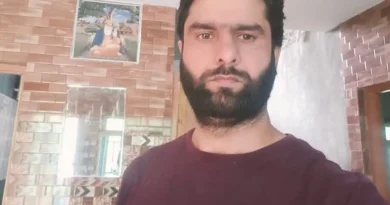

Yasin Malik denies role in Sarla Bhat murder case, seeks death penalty
Srinagar, Sep 3: Jailed chief of banned Jammu and Kashmir Liberation Front (JKLF) Mohammad Yasin Malik, an accused in the murder of a Kashmiri Pandit woman, has submitted a detailed 25-page affidavit before a special court here, pleading not guilty but refusing to contest the case and asking for capital punishment.
He claimed that the charges read more like a fabricated story than a legitimate police investigation, arguing that the case was constructed decades later purely to frame him.
In the affidavit, 60-year-old Malik, who is lodged in Delhi’s Tihar jail, also announced his decision to dissolve his marriage with his wife, Mushaal Hussein Mullick, citing his prolonged incarceration and inability to communicate with his family over the past eight years as he did not have any access to phone calls or video conferencing.
“Before I will be hanged, I have taken the decision to separate you from the bond of our Nikah,” Malik wrote to his wife in the same affidavit and advised his daughter to call her grandparents every day for five minutes.
In the affidavit, verified and attested at Central Jail No. 7, Tihar, Malik declared his decision to stop contesting the ongoing trial proceedings, stating that he has put his entire case in the hands of God.
“Considering my personal circumstances and after deep reflection, I have decided not to contest the trial proceedings further. My decision shall not be treated as an admission of any prosecution fact, guilt or acceptance of the allegations made against me. I request for capital punishment,” Malik stated in his court submission.
The JKLF chief maintained that he has been falsely implicated due to political considerations.
The affidavit from Malik comes after the State Investigating Agency (SIA) on June 29 filed a chargesheet in connection with the murder of Sarla Bhat, a young Kashmiri Pandit woman, who lost her life on April 19, 1990. He has been named as an accused in the case.
Malik strongly refuted the SIA’s allegations, calling them a “subsequent invention” framed after more than three decades and argued that during April 1990, he was critically injured following a fall from a building during a BSF raid at Narwara, remained in a coma, and was twice reported dead by news outlets including the state-run Doordarshan.
“It is incomprehensible how a person who was unconscious, fighting for his own survival and widely believed to be dead could have participated in, directed or orchestrated the commission of the offence,” Malik claimed, adding that Sarla Bhat was an innocent civilian and denying that she acted as a security informer.
He said Bhat was neither working for the security forces in any covert capacity nor was she in any manner responsible for the raid conducted at Narwara where he was holed up.
“In my view, She (Bhat) was as innocent civilian as my own 13-year-old daughter Raziya Sultana,” Malik said.
He expressed shock that he has been named as accused in the case more than three decades since the killing.
Prior to the filing of the chargesheet, Malik said that three SIA officers visited him in Tihar jail and questioned him about only two allegations – a handwritten note issued by the JKLF recovered from the scene of occurrence claiming responsibility and mentioning three names Javaid Mir, Sheikh Abdul Hamid and Mohammad Yasin Malik, and the second that the JKLF ordered Bhat’s killing as they suspected her of passing information to security persons regarding Malik’s presence in the house of one Hafiz Bazaz.
“If this handwritten note, which is now accepted by the SIA as gospel truth, was recovered at the scene of the alleged killing then why did the authorities not implicate the three persons named in the letter for three decades,” he said in the affidavit.
He also referred to the then Governor Jagmohan and said he was regarded by a large section of the Kashmiri Pandit community as their protector but he never suggested that Malik was responsible for the killing of Bhat or any Kashmiri Pandit.
Malik further said that when he was arrested in August 1990, nearly two dozen cases under the TADA were registered against him but he was never named as accused in the Bhat killing.
“Had such an incriminating letter genuinely existed, there was absolutely no reason for the investigating agencies to exclude this case. The omission itself completely belies the prosecution’s present version and demonstrates that the allegation is nothing but a subsequent invention,” the affidavit said.
Similarly no case was lodged against the two others purportedly named in the letter even though they were too arrested in the 1990s, it added.
Malik said the investigating agency’s chargesheet naming him as an accused in the case was nothing more but an afterthought.
“The prosecution’s present narrative resembles a fictional story rather than a genuine criminal investigation, carefully woven together after several decades solely with the object of falsely implicating me in the present case,” the affidavit claimed.
The JKLF chief further claimed that he has never advocated or resorted to violence or retaliation against any individual and that his character is not such where he would order the killing of an innocent person out of revenge.
He termed the prosecution case as “implausible, wholly false and unsupported by evidence” and said the fresh case is because of present political circumstances and decisions.
Malik also dropped many names during his earlier tenures in the jails which included of his meetings with the then senior Intelligence Bureau officials, BJP and Congress leaders, top businessmen and those handling the “Track II diplomacy” with Pakistan.
In his affidavit, Malik informed the court that he had done an ‘Istikhara’, a special prayer and supplication used to ask God’s guidance and the best choice when facing a decision, before deciding to separate from his wife.
Noting that his wife is 20 years younger than him, Malik expressed that he does not wish for her to spend the remainder of her life carrying the burden of his circumstances or living as a widow. Quoting former South African President Nelson Mandela’s writings on the personal sacrifices of political life, he urged her to start a new chapter with dignity.
Malik also penned a message to his 13-year-old daughter, Raziya Sultana, whom he hasn’t heard for the last eight years. “In my death cell, there is only myself and your photograph. Through your picture, I feel your presence with me twenty-five hours a day,” the affidavit said.
Ending his submission with verses from poet Faiz Ahmed Faiz and passages from the Quran, Malik described the document as his “final statement of conscience”.
“I bear no hatred towards any individual. I do not seek revenge against anyone. I leave every act, every accusation, every decision and every injustice to the ultimate judgment of Almighty Allah,” he said. (PTI)

Press Trust of India (PTI) is India’s premier news agency.