
Jammu Gets Larger Share in Several Key Schemes Under NC Government, Official Data Shows
Arif Rashid
Srinagar: Official data placed before the Jammu and Kashmir Legislative Assembly indicates that Jammu Division has received a substantially larger financial share in several key schemes under the Omar Abdullah-led government, although no consolidated Jammu-versus-Kashmir expenditure statement has been published covering all departments since the government assumed office in October 2024.
The available government records show significant regional differences in sectors including school education and watershed development, while expenditure on tourism promotion has remained almost evenly divided between the two divisions.
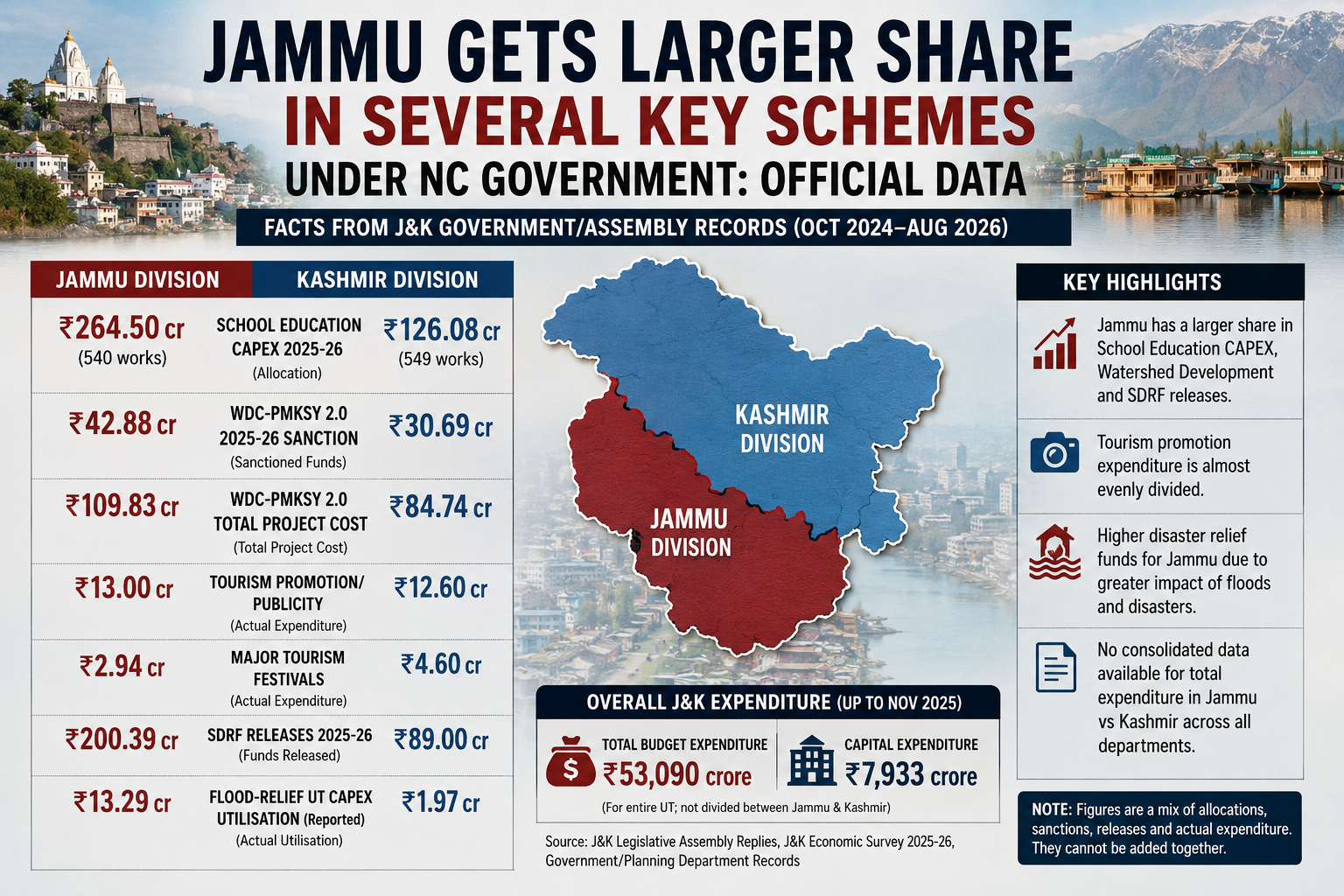
Under School Education CAPEX for 2025-26, the government approved 1,089 works across Jammu and Kashmir. Of these, 540 works were approved in Jammu Division with an allocation of ₹264.50 crore, while 549 works were approved in Kashmir Division with an allocation of ₹126.08 crore.
Thus, despite Kashmir having nine more approved works, Jammu received around ₹138.42 crore more, accounting for approximately 68 per cent of the combined allocation under the programme.
A similar pattern is visible under the Watershed Development Component of the Pradhan Mantri Krishi Sinchayee Yojana (WDC-PMKSY) 2.0. The total project cost of sanctioned projects stood at around ₹194.57 crore, with ₹109.83 crore allocated to Jammu Division and ₹84.74 crore to Kashmir Division.
For 2025-26 specifically, sanctions under the watershed programme amounted to ₹42.88 crore for Jammu and ₹30.69 crore for Kashmir, giving Jammu an advantage of approximately ₹12.19 crore.
However, the regional distribution is not uniformly tilted towards Jammu across all sectors.
In tourism promotion and publicity, government figures indicate expenditure of approximately ₹13 crore in Jammu and ₹12.60 crore in Kashmir, making the overall spending almost evenly divided between the two divisions.
Expenditure on major tourism festivals showed a different pattern, with ₹4.60 crore spent in Kashmir against ₹2.94 crore in Jammu during the period covered by the government reply.
Disaster-response funding also shows a significant difference, but these figures need to be viewed in the context of the extent of damage suffered by the two divisions.
During 2025-26, the government reported ₹289.39 crore released under the State Disaster Response Fund (SDRF), including ₹200.39 crore for Jammu Division and ₹89 crore for Kashmir Division.
Jammu’s share therefore constituted around 69 per cent of the reported SDRF releases. The government data, however, attributes the higher allocation to the substantially greater impact of floods and other disasters in Jammu Division.
Under a separate ₹100-crore UT CAPEX provision for urgent flood-related restoration, the government reported utilisation of ₹13.29 crore in Jammu Division and ₹1.97 crore in Kashmir Division at the stage covered by the Assembly reply.
The overall budgetary figures underline the scale of expenditure taking place across the Union Territory. According to the J&K Economic Survey, the government had incurred ₹53,090 crore in total budget expenditure by November 2025, including ₹7,933 crore in capital expenditure. These figures, however, are for the Union Territory as a whole and are not divided into Jammu and Kashmir.
The data also highlights an important limitation in making a broader political comparison. The government has not published a single consolidated statement showing the total amount actually spent in Jammu and Kashmir separately across all departments since October 2024.
Consequently, it would be misleading to simply add figures from different schemes and describe the result as the total expenditure of the NC government in either division. Some of the figures available in government records represent allocations or sanctions, while others represent funds released or actual utilisation.
The available evidence nevertheless establishes that Jammu has received a larger financial share in several identifiable development programmes, particularly School Education CAPEX and watershed development, while tourism promotion has remained broadly balanced and disaster-related spending has been higher in Jammu in line with the reported scale of damage.
The figures therefore provide evidence of sector-specific regional differences, but do not, by themselves, establish that the overall development expenditure of the NC government has been higher in Jammu than Kashmir or vice versa.
For a definitive Jammu-versus-Kashmir comparison, a department-wise compilation of actual expenditure under Roads and Buildings, Jal Shakti, Health, Power, Rural Development, Urban Development, Education, Tourism, Agriculture, Social Welfare and District/UT CAPEX would be required.
Sources: J&K Legislative Assembly replies; J&K Government/Planning Department records; J&K Economic Survey 2025-26 and departmental CAPEX data.

ANN News is the first and only 24*7 Tv News Channel of Kashmir, having its headquarters at Srinagar. ANN News is available on all leading cable Networks, Also Available On JIO Tv , Vodafone,TataPlay , Candor Network, Dailyhunt and other leading Platforms