₹30 at Kokernag, ₹50 at Verinag, ₹100 at Betaab Valley: What’s the Logic Behind Kashmir’s Tourist Entry Fees?
Wide Variation in Ticket Rates at Tourist Parks Raises Questions Over Fee-Fixation Policy
Arif Rashid
Anantnag, June 10: The significant variation in entry fees charged at government-managed tourist parks and gardens across Kashmir has raised questions about the policy and criteria adopted for fixing ticket rates at public tourist destinations.
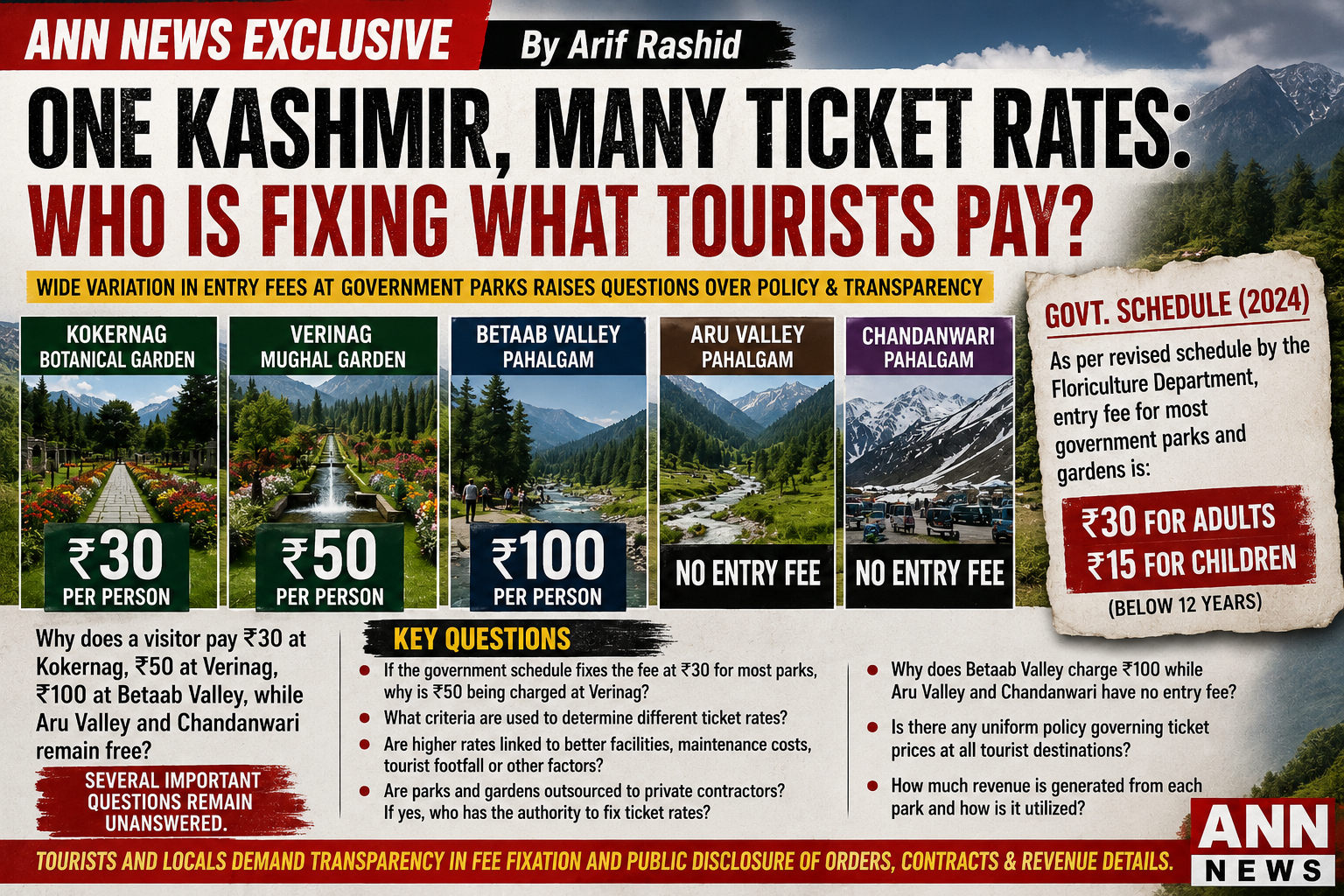
As per the revised fee schedule issued by the Floriculture Department in 2024, the standard entry fee for most government parks and gardens was fixed at ₹30 for adults and ₹15 for children. However, visitors continue to encounter different rates at various tourist destinations.
For instance, Kokernag Botanical Garden charges ₹30 per visitor, while Verinag Mughal Garden charges ₹50. The disparity becomes even more pronounced in the Pahalgam tourist circuit, where Betaab Valley charges ₹100 per adult visitor, whereas entry to Aru Valley and Chandanwari remains free, excluding parking and other local charges.
The variation in ticket rates has prompted visitors and local stakeholders to seek clarity on the basis of fee fixation at public tourist sites.
Several important questions arise:
• If the Floriculture Department’s revised schedule fixed the entry fee for most gardens at ₹30, why are visitors being charged ₹50 at Verinag?
• What criteria are used to determine ticket prices at different government-owned tourist destinations?
• Are higher rates linked to better facilities, maintenance costs, tourist footfall, or other factors?
• Have certain gardens and parks been outsourced to private contractors, and if so, what role do contractors play in fixing entry fees?
• Is there any officially notified policy explaining why Betaab Valley charges ₹100 while Aru Valley and Chandanwari have no entry fee?
• Why is there no publicly available uniform framework governing ticket prices across government-managed tourist destinations?
Tourism stakeholders argue that while visitors may not object to paying reasonable fees for maintenance and development, transparency in fee fixation is essential. Public parks and tourist destinations are important public assets, and citizens have a right to know how entry charges are determined and how the revenue generated is utilized.
With Kashmir witnessing a steady increase in tourist arrivals, there is a growing demand for the concerned departments to make public the official orders, contracts, and guidelines governing ticket prices at all government-managed gardens and tourist parks.
The issue is not merely about the amount being charged, but about ensuring transparency, accountability, and a clear policy framework for vi


sitors across Jammu and Kashmir.

ANN News is the first and only 24*7 Tv News Channel of Kashmir, having its headquarters at Srinagar. ANN News is available on all leading cable Networks, Also Available On JIO Tv , Vodafone,TataPlay , Candor Network, Dailyhunt and other leading Platforms